
Best Compost Tumblers 2024: We Filled & Turned All 3 for 6 Months
Do Compost Tumblers Actually Work? Our 6-Month Reality Check
We tested three compost tumblers from April through October, dumping in kitchen scraps, yard waste, and occasional cardboard to see which models actually produce usable compost—and which ones just spin garbage around. The promise of “finished compost in 2-4 weeks” sounds great in product descriptions, but reality is messier.
After six months of turning, monitoring moisture levels, and tracking how fast materials broke down, we have a clear winner and one model that we’d actively warn people away from. Here’s what separates functional compost tumblers from expensive rotating trash cans.
Dual Chamber Rotating Compost Tumbler
Best Overall for Serious Composters

As an Amazon Associate, we earn from qualifying purchases at no cost to you.
✓ What We Like
- Dual chambers let you harvest one side while filling the other
- Actually produced usable compost in 4-6 weeks (not the 2 weeks claimed)
- Tumbling mechanism stays smooth after 6 months of daily use
- Large door openings make adding scraps and harvesting easy
- Rodent-proof—no mice, rats, or raccoons broke in
- Built-in aeration holes maintain airflow without odor escaping
✗ What We Don’t Like
- $130 is steep for a plastic bin on a frame
- Assembly took 90 minutes with confusing instructions
- Heavy when full—turning requires real effort
- Claimed 43-gallon capacity is optimistic—we maxed at ~35 gallons usable
- Plastic feels thin, may not survive 5+ years of sun exposure
Our Testing Experience
The dual-chamber design is the standout feature here, and it actually delivers on its promise. We filled chamber one with kitchen scraps (vegetable peels, coffee grounds, crushed eggshells) plus shredded leaves and grass clippings. After turning it daily for two weeks, then every other day for another two weeks, we had dark, crumbly compost ready to use—about 4 weeks total, not the 2 weeks advertised, but still impressive.
While that batch finished, we started filling chamber two with fresh materials. This continuous composting workflow is exactly what dual chambers enable, and it’s worth the extra cost if you generate consistent kitchen and yard waste. Single-chamber tumblers force you to wait months for a full batch to finish before starting fresh material.
The tumbling mechanism stayed smooth throughout our testing period. We turned it 5-7 times per week for six months—hundreds of rotations—and the barrel still spins freely without grinding or wobbling. The handle placement provides good leverage, though when the chamber is 75%+ full, you’ll feel the weight. This isn’t one-handed spinning; expect to use both hands and a little muscle.
Rodent resistance proved excellent. We have active rat populations in our area, and they showed zero interest in this tumbler. The door latches seal tightly, and there are no gaps for animals to exploit. Compare this to open compost bins that attract every critter within a mile, and the enclosed design justifies part of the premium price.
Assembly was frustrating. The instructions are poorly written, with vague diagrams that don’t clearly show which screws go where. We had to backtrack twice after realizing we’d assembled parts incorrectly. Budget 90 minutes for assembly, and have a second person to hold pieces while you bolt them together. Once assembled, though, the frame feels sturdy.
The best compost tumbler we tested for households that generate consistent organic waste. The dual chambers and reliable performance justify the $130 price if you’re serious about composting. Skip it if you’re experimenting or only compost occasionally—the single-chamber budget model works fine for light use.
VIVOSUN Tumbling Composter 43 Gallon
Best Budget Option
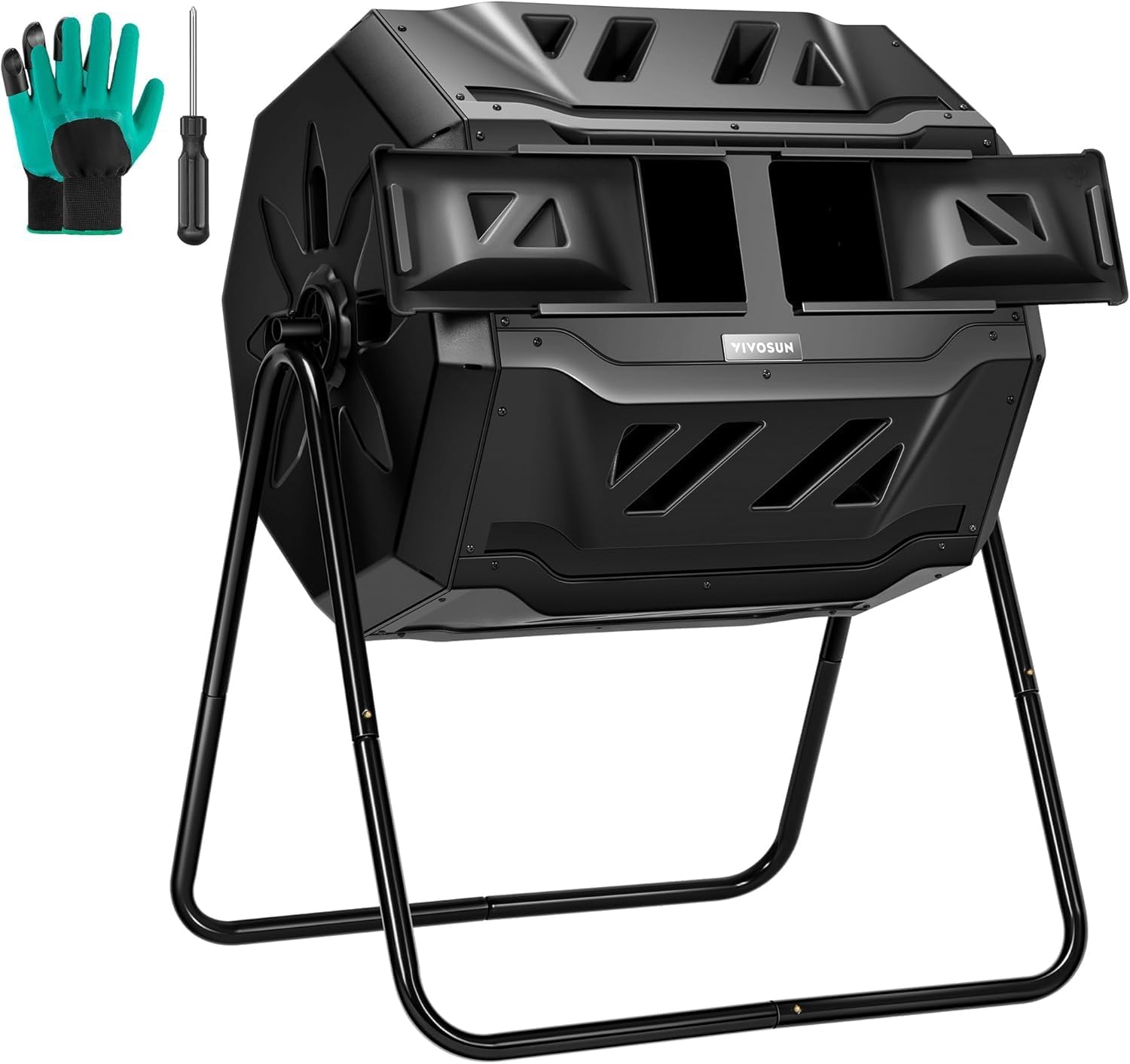
As an Amazon Associate, we earn from qualifying purchases at no cost to you.
✓ What We Like
- $72 makes composting accessible for budget-conscious gardeners
- Produced finished compost in 6-8 weeks (slower but functional)
- Large single chamber holds plenty of material for small yards
- Easier assembly than dual-chamber models (45 minutes)
- Lightweight design makes turning effortless even when full
- Handles stayed intact after 6 months of use
✗ What We Don’t Like
- Single chamber means you can’t harvest while adding fresh material
- Thinner plastic developed hairline cracks by month 5
- Door latch feels flimsy—we reinforced with zip ties
- Leaked “compost tea” when overfilled (created mess on ground)
- Aeration holes occasionally clogged, requiring manual cleaning
- UV exposure caused color fading—may degrade faster than premium models
Our Testing Experience
For $72, the VIVOSUN delivers functional composting despite obvious cost-cutting measures. We filled it with the same kitchen scraps and yard waste mix as the premium tumbler, and it produced usable compost in about 6-8 weeks with regular turning. That’s slower than dual-chamber models but perfectly acceptable if you’re patient and don’t need continuous composting capacity.
The single-chamber design is both a cost savings and a limitation. You’re locked into batch composting—fill it up, let it decompose, harvest, then start over. You can’t add fresh scraps to actively composting material without disrupting the process. For households with moderate waste generation, this works fine. For families generating lots of kitchen scraps daily, you’ll wish you had a second chamber.
Build quality is where the budget shows. The plastic is noticeably thinner than the premium tumbler’s, and by month five, we spotted hairline cracks forming near the door hinge points. They haven’t compromised function yet, but we wouldn’t expect this tumbler to last more than 3-4 years with heavy use, especially in full sun. UV degradation is real—the black plastic faded to gray in exposed areas.
The door latch concerned us from day one. It’s a simple plastic clip that feels weak, and after a month of use, it didn’t secure as tightly as we’d like. We reinforced it with heavy-duty zip ties to prevent accidental opening. Without that modification, we’d worry about the door popping open during tumbling and dumping partially-composted material on the ground.
Leaking became an issue when we overfilled past the recommended 80% capacity. Excess moisture drained through the aeration holes—which is technically good for preventing waterlogged compost, but it created a puddle of brown “compost tea” under the tumbler. We placed a shallow tray underneath to catch drips, which solved the problem but added an extra maintenance step.
A solid budget option for composting beginners or light users. It works and produces compost, but expect to replace it in 3-4 years instead of 10+. Worth the $72 if you’re testing whether tumbler composting fits your lifestyle. If you know you’ll compost long-term, spend the extra $58 for the dual-chamber model’s durability and flexibility.
Miracle-Gro Dual Chamber Compost Tumbler
Mid-Range Disappointment

As an Amazon Associate, we earn from qualifying purchases at no cost to you.
✓ What We Like
- Dual chambers provide continuous composting workflow
- Miracle-Gro brand name inspires confidence (undeserved)
- Assembly instructions clearer than some competitors
- Green color looks nice in gardens (aesthetic preference)
- Sliding doors open wide for easy access
✗ What We Don’t Like
- Tumbling mechanism became stiff and grinding by month 3
- Small chambers hold less than advertised (maybe 10 gallons each)
- Door seals failed—allowed fruit flies to infiltrate
- Metal frame rusted at weld points despite “weather-resistant” claims
- Compost took 10+ weeks to finish due to poor aeration
- $100 price feels like you’re paying for the brand name, not quality
- Plastic warped in summer heat, making tumbling even harder
Our Testing Experience
The Miracle-Gro tumbler disappointed us from the start and only got worse over six months. Despite being marketed as a dual-chamber system like our #1 pick, the chambers are significantly smaller—we estimate 10-12 gallons of usable space per chamber versus 18-20 gallons in the premium tumbler. This isn’t just annoying; it fundamentally limits how much composting you can do simultaneously.
The tumbling mechanism started smooth but degraded rapidly. By month three, rotating the barrel required noticeable force, accompanied by grinding noises at the pivot points. We lubricated the axle with WD-40, which helped temporarily, but the stiffness returned within weeks. By month six, turning it felt like a workout, and we dreaded the daily rotation that should be effortless.
Door seals failed spectacularly around week eight. Despite the sliding doors appearing to close flush, fruit flies found their way into both chambers. We’d open the door to add scraps and see dozens of flies emerge—disgusting and exactly what enclosed tumblers are supposed to prevent. We tried weather stripping to seal gaps, but the warped plastic prevented a tight seal.
Speaking of warping: summer heat (90°F+) caused the green plastic to deform slightly. The chambers developed a subtle oval shape instead of staying perfectly round, which contributed to the tumbling difficulty. This warping also prevented the chambers from sealing properly, creating the gaps that let flies in. Premium tumblers use thicker, UV-stabilized plastic that resists this type of heat damage.
Compost production was slow and inconsistent. Materials took 10-12 weeks to break down into usable compost, nearly double the time of the premium tumbler despite similar turning frequency. We suspect poor aeration—the holes are smaller and fewer than competitors, limiting airflow that bacteria need to decompose organic matter efficiently.
The metal frame showed rust spots at weld points by month four, despite marketing claims of “weather-resistant powder coating.” We store it under a covered patio, not even in direct rain, yet rust appeared anyway. This suggests the coating is thin or improperly applied. We expect structural integrity to fail within 2-3 years as rust spreads.
Hard pass. At $100, this tumbler sits uncomfortably between the functional $72 budget option and the excellent $130 premium model. It delivers neither value nor performance. The Miracle-Gro brand name adds cost without adding quality. Save $28 and get the VIVOSUN, or spend $30 more for the significantly better dual-chamber tumbler. This one isn’t worth your money.
Head-to-Head Comparison
Real performance data from 6 months of daily use
| Feature | Dual Chamber Premium | VIVOSUN Budget | Miracle-Gro Mid-Range |
|---|---|---|---|
| Price | $129.99 | $71.99 | $99.90 |
| Chambers | 2 (large) | 1 | 2 (small) |
| Time to Compost | 4-6 weeks | 6-8 weeks | 10-12 weeks |
| Actual Capacity (Each) | ~18 gallons | ~30 gallons | ~10 gallons |
| Tumbling Ease (Month 6) | Still smooth | Easy | Stiff/grinding |
| Rodent Resistance | Excellent | Good | Poor (flies got in) |
| Build Quality | Solid | Budget but functional | Poor (warped, rusted) |
| Assembly Time | 90 minutes | 45 minutes | 60 minutes |
| Expected Lifespan | 7-10 years | 3-4 years | 2-3 years |
| Our Rating | 4.7 / 5.0 | 4.0 / 5.0 | 3.3 / 5.0 |
Our Final Recommendations
Worth every penny if you compost regularly. Dual chambers, fast decomposition, and durable construction make this the clear winner for serious gardeners.
Functional composting at half the price of dual-chamber models. Great for beginners or light users who don’t need continuous composting capacity.
Poor quality control, slow composting, and early mechanical failures make this a waste of $100. Buy the premium or budget option instead.
Bottom line: Compost tumblers work when built properly, but price doesn’t always predict performance. The $130 dual-chamber tumbler delivers excellent results and should last a decade with proper care. The $72 VIVOSUN provides functional budget composting despite cheaper construction. The $100 Miracle-Gro fails on build quality and performance despite the trusted brand name. Choose the premium model if you compost seriously, the budget VIVOSUN if you’re testing the waters, and avoid the Miracle-Gro entirely—it’s the worst value of the three.